
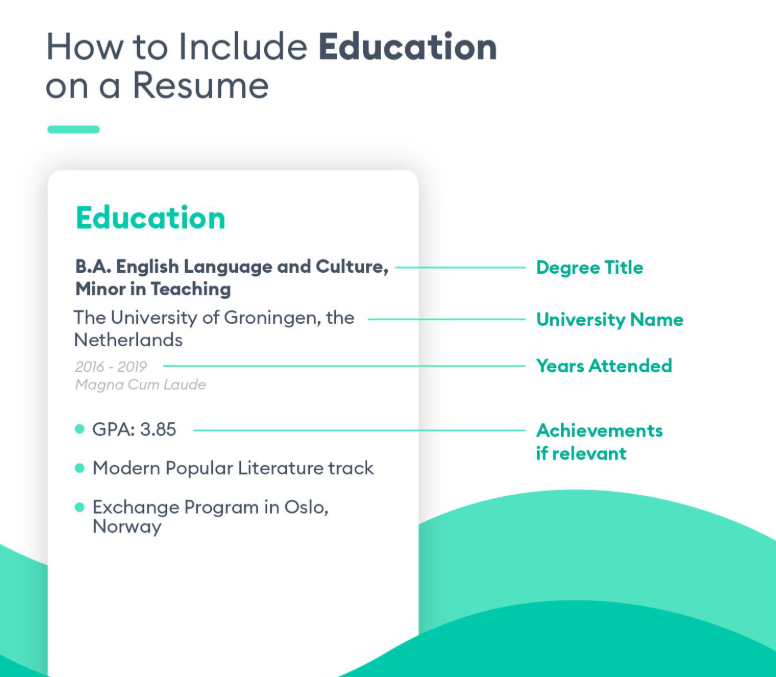
Knowing how to list education on a resume can make your resume clearer and help employers quickly understand your academic background. Whether you are a recent graduate, an experienced professional, or a student looking for your first job, the education section should present your qualifications in a simple and professional format.
The best approach depends on your experience level, the position you are applying for, and the relevance of your education to the job.
How to List Education on a Resume
A typical education entry should include:
- Degree or qualification
- Major or field of study
- School, college, or university name
- Location, if relevant
- Graduation date or expected graduation date
- Relevant academic achievements, when appropriate
Basic Resume Education Format
A simple format is:
Degree or Qualification
University or Institution Name, Location
Graduation Year
For example:
Bachelor of Business Administration
ABC University, New Delhi
2025
Keep the formatting consistent with the rest of your resume.
Where Should the Education Section Go on a Resume?
The position of the education section depends largely on your career experience.
For Recent Graduates
If you recently graduated and have limited professional experience, placing education near the top of your resume can be effective.
You can place it after your professional summary or objective.
For Experienced Professionals
If you have several years of relevant work experience, your experience section will usually be more important. In this case, education can appear after your professional experience.
For Students
Students can place education near the top of the resume, especially when they do not yet have substantial professional experience.
How to List a Bachelor’s Degree on a Resume
Write the full degree name followed by your major or specialization if relevant.
For example:
Bachelor of Science in Computer Science
XYZ University
2024
You can also use a commonly recognized abbreviation:
B.Sc. in Computer Science
XYZ University
2024
Choose one format and use it consistently throughout your resume.
How to List a Master’s Degree on a Resume
A master’s degree can be listed in the same format.
For example:
Master of Business Administration (MBA)
ABC University
2025
If the specialization is important to the position, include it:
Master of Business Administration, Marketing
ABC University
2025
How to List High School Education on a Resume
Whether you should include high school depends on your education level and professional experience.
If you have completed college or a higher qualification, high school education is usually unnecessary unless an employer specifically requests it.
For someone without a college degree, however, high school education may be relevant.
Example:
High School Diploma
ABC Senior Secondary School
2022
How to List Education If You Are Still Studying
If you are currently enrolled in a program, list your expected graduation date.
For example:
Bachelor of Arts in English
XYZ University
Expected Graduation: 2027
You can also write:
Bachelor of Arts in English
XYZ University
2024–Present
Using an expected graduation date makes it clear that the degree has not yet been completed.
How to List an Incomplete Degree
If you attended college or university but did not complete the degree, you should present the information honestly.
For example:
Bachelor of Commerce Coursework
ABC University
2022–2024
You should not list an incomplete degree as though you graduated.
Should You Include Your GPA?
Including your GPA is optional.
For recent graduates or students with a strong academic record, a high GPA may strengthen the resume. Experienced professionals generally do not need to include GPA unless it is specifically requested or particularly relevant.
Example:
Bachelor of Science in Mathematics
XYZ University
2025 | GPA: 3.8/4.0
Always use the grading scale that applies to your educational system and avoid misleading conversions.
Should You Include Relevant Coursework?
Relevant coursework can be useful when you have limited professional experience.
For example:
Bachelor of Computer Science
XYZ University | 2026
Relevant Coursework:
- Data Structures
- Database Management
- Web Development
- Software Engineering
Choose courses that directly relate to the job rather than listing every subject you studied.
Should You Include Academic Honors and Awards?
Yes, relevant academic achievements can strengthen the education section, particularly for students and recent graduates.
Examples include:
- Dean’s List
- Academic scholarships
- Graduation honors
- Department awards
- Academic competitions
- Research awards
For example:
Bachelor of Arts in Economics
ABC University | 2025
- Graduated with honors
- Academic scholarship recipient
How to List Multiple Degrees on a Resume
If you have multiple qualifications, list them in reverse chronological order, starting with the most recent.
Example:
Master of Business Administration
ABC University | 2026
Bachelor of Commerce
XYZ University | 2023
This makes your most recent educational achievement immediately visible.
Education Section Resume Examples
Example for a Recent Graduate
Education
Bachelor of Computer Applications
ABC University, Jaipur
2026
Relevant Coursework: Web Development, Database Management, Programming
Example for an Experienced Professional
Education
Master of Business Administration
XYZ University
2020
Bachelor of Commerce
ABC University
2017
For experienced professionals, the education section can be concise because professional experience is usually more important.
Example for a Current Student
Education
Bachelor of Science in Information Technology
ABC University
Expected Graduation: 2027
Relevant Coursework: Programming, Networking, Database Systems
Common Mistakes When Listing Education on a Resume
Avoid these common errors:
1. Providing Too Much Information
Your education section should be concise. You generally do not need to include every course, school activity, or subject.
2. Using Inconsistent Formatting
Use the same font, spacing, date format, and structure throughout your resume.
3. Listing Unfinished Degrees as Completed
Always clearly indicate whether a qualification is in progress.
4. Including Outdated Information
As your career progresses, older and less relevant educational details may become less important.
5. Adding Unnecessary Personal Details
Your education section generally does not need information such as your parents’ names, religion, marital status, or other unrelated personal details.
Final Tips for Listing Education on a Resume
When creating your education section, remember these best practices:
- Start with your most recent qualification.
- Use the official name of your degree.
- Include your institution.
- Add graduation or expected graduation dates.
- Highlight relevant achievements when useful.
- Include relevant coursework if you have limited work experience.
- Keep the section concise.
- Tailor your education details to the position when appropriate.
- Never exaggerate or misrepresent your qualifications.
Frequently Asked Questions
How do I list education on a resume?
Include your degree or qualification, institution name, location if relevant, and graduation or expected graduation date. You can also include relevant coursework, honors, or academic achievements.
Should education go before work experience?
For students and recent graduates, education can appear before work experience. For experienced professionals, work experience usually comes first.
Do I need to list high school on my resume?
If you have completed college or a higher qualification, high school is generally not necessary unless the employer specifically requests it.
Should I include my GPA on my resume?
A strong GPA can be useful for students and recent graduates. Experienced professionals generally do not need to include it unless relevant.
How do I list a degree I am currently pursuing?
Include the degree and institution and clearly state the expected graduation date, such as “Expected Graduation: 2027.”
Conclusion
Learning how to list education on a resume is an important part of creating a professional job application. Your education section should make your qualifications easy to understand without taking attention away from more important information.
Use a clear format, list qualifications in reverse chronological order, include relevant achievements when appropriate, and always accurately represent your educational background. By tailoring your education section to your experience level and the job you want, you can create a stronger and more focused resume.